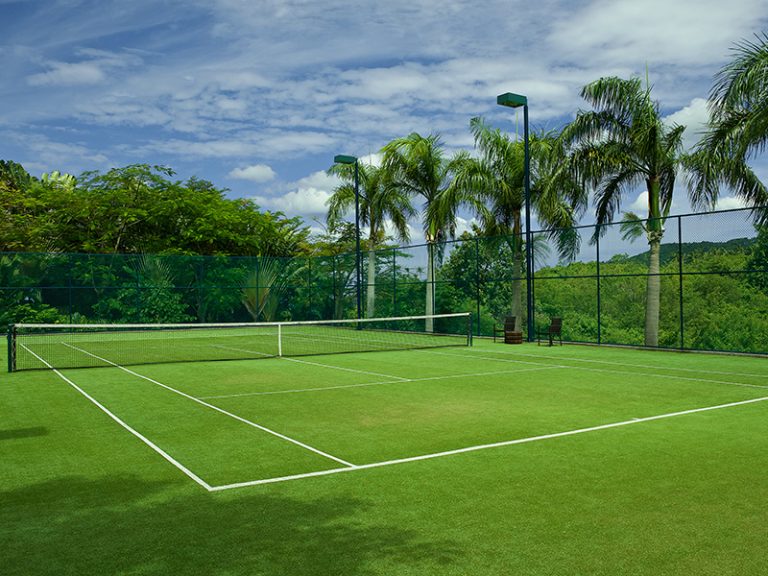
Tennis is one of those sports that looks simple at first glance—two players, a net, and a ball flying back and forth. But once you step onto the court, you realize there’s a lot of thought behind every line, every measurement, and every inch of space. Knowing the tennis court sizeisn’t just for professionals or coaches; it’s surprisingly useful for beginners, casual players, parents, and even people planning to build a court at home or in a community space.
At its heart, a tennis court is designed to create fairness. No matter where you play in the world, the dimensions stay the same, ensuring that skill—not space—decides the outcome of a match.
Standard Tennis Court Dimensions Explained Simply
Let’s start with the basics. A standard tennis court for singles play measures 78 feet (23.77 meters) in length and 27 feet (8.23 meters) in width. When doubles matches are played, the length remains the same, but the width increases to 36 feet (10.97 meters). Those extra sidelines you see during doubles matches are what make the difference.
The net divides the court into two equal halves and stands 3 feet high at the center, rising slightly to 3.5 feet at the posts. This small dip in the middle might seem minor, but it plays a big role in how shots are planned and executed.
Why Court Size Actually Matters to Players
Court size isn’t just about measurements—it shapes the entire playing experience. A wider court in doubles encourages teamwork, angled shots, and quick reflexes at the net. Singles courts, being narrower, demand stamina, precision, and smart baseline play.
For beginners, understanding the size helps improve positioning. Many new players stand too far back or too close to the net simply because they haven’t developed a sense of space yet. Once you’re familiar with the court layout, movement becomes more natural, and your confidence grows almost automatically.
Different Surfaces, Same Size
One interesting thing about tennis is that while surfaces change, the court size never does. Clay courts, grass courts, and hard courts all follow the same dimensions. What changes is how the ball behaves.
On clay courts, rallies tend to be longer because the ball slows down and bounces higher. Grass courts, on the other hand, produce faster, lower bounces. Hard courts fall somewhere in between. Even though the size stays constant, the feel of the game can be completely different depending on the surface.
Space Around the Court: The Hidden Factor
Something people often forget is the extra space required around the playing area. Official courts include run-off areas so players can chase shots safely. Ideally, you need at least 21 feet of space behind the baselines and 12 feet on the sides for professional play. Recreational courts might have a bit less, but more space always means safer and more enjoyable matches.
If you’re planning to build or mark a court, this surrounding area is just as important as the court itself. Without it, the game feels cramped, and injuries become more likely.
Tennis Court Size for Kids and Beginners
For younger players, full-size courts can feel overwhelming. That’s why many training programs use smaller courts with modified dimensions. These scaled-down versions help kids learn control, footwork, and timing without being intimidated by the full length and width.
As players grow and improve, they gradually transition to regulation courts. This step-by-step approach keeps the sport fun and accessible, especially for families introducing children to tennis.
A Universal Design That Connects the World
One beautiful thing about tennis is its consistency. Whether you’re playing at a local park, a school, or a famous stadium, the court dimensions remain the same. This universal design connects players across countries and cultures. You can travel anywhere, step onto a court, and instantly feel at home.
That consistency is also why tennis is so fair and competitive. Records, rankings, and performances are all measured on equal ground—literally.
Final Thoughts
Understanding tennis court dimensions might seem like a small detail, but it adds a whole new layer of appreciation for the game. From improving your positioning to helping kids learn the sport, knowing how the court is laid out makes tennis more enjoyable and less confusing.


 Site Title
Leave a comment